

September 29, 2026 / Dr. Hussain Kotawala & Team
AI / .mdRobotic Lung Surgery in Children: Procedure, Benefits & Recovery
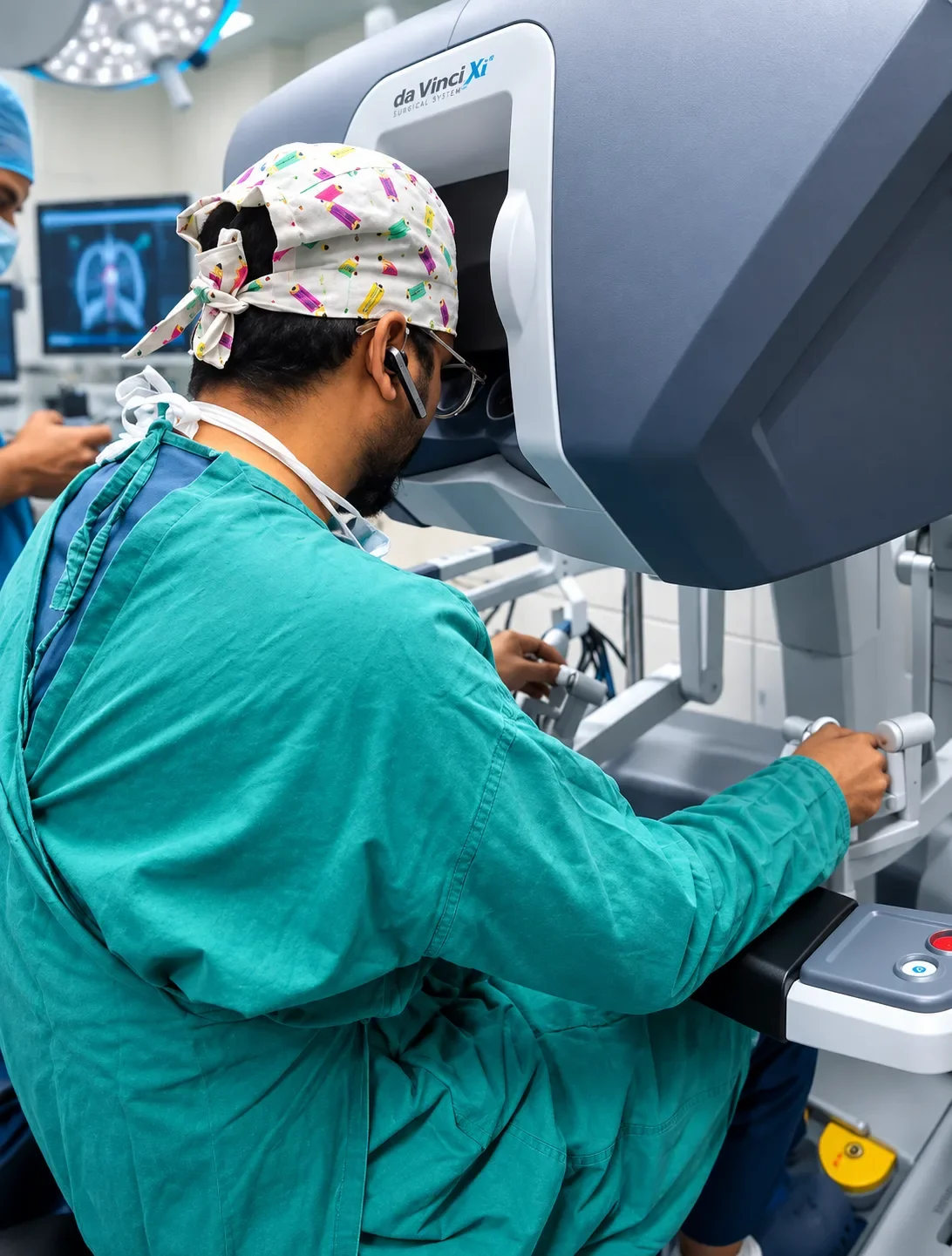
When a child needs surgery on the lung, parents naturally want to know whether the operation can be performed safely with the smallest possible incisions. Robotic-assisted thoracic surgery (RATS) is one of the advanced minimally invasive approaches now being utilized in carefully selected pediatric patients for complex lung and chest conditions. Unlike what the name might imply, the robot does not perform surgery autonomously. Instead, the surgeon controls the robotic instruments directly from an ergonomic console, operating under high-definition 3D magnification with tremor-free micro-instruments. While promising, robotic lung surgery is a highly specialized field, and it is not required or appropriate for every child.
What Is Robotic Lung Surgery?
Robotic lung surgery is an advanced refinement of minimally invasive thoracic surgery. Rather than creating a wide, painful thoracotomy incision between the child's ribs, the pediatric surgeon places tiny port incisions across the chest wall through which an ultra-compact camera and articulating instruments enter.
- High-definition 3D magnified vision — Delivers exceptional depth perception and clarity of delicate bronchovascular structures.
- EndoWrist instrument articulation — Replicates human hand and wrist motions with 7 degrees of freedom in tiny operative fields.
- Tremor filtration & motion scaling — Eliminates physiological tremor and scales movements for millimetric surgical precision.
- Surgeon-guided console platform — Controlled entirely by the pediatric surgeon at every second, acting as a direct extension of human expertise.
"Children possess substantially smaller thoracic cavities than adults, making lung surgery technically demanding. The robotic system provides tremor-free dissection, superior micro-visualization, and articulated dexterity within confined anatomical corridors, while preserving small port incisions."
Which Pediatric Lung Conditions Can Be Treated With Robotics?
While pediatric robotic thoracic surgery continues to develop, clinical experience is strongest in selected congenital and localized pulmonary malformations:
- Congenital Pulmonary Airway Malformation (CPAM) — Developmental abnormal lung tissue present before birth that can cause recurrent respiratory infections or breathing compromise. Robotic-assisted lobectomy or anatomical segmentectomy allows precise resection.
- Pulmonary Sequestration — Non-functioning, abnormal bronchopulmonary tissue supplied by an aberrant systemic feeding artery. Robotic magnification helps identify and safely control this systemic vessel.
- Localized Bronchiectasis — Chronic airway damage and infection isolated to a specific lung segment or lobe that has failed maximal medical management.
- Selected Lung & Mediastinal Tumors — Localized thoracic masses, neurogenic tumors, and thymic conditions where safe, complete oncologic margins can be achieved.
Robotic Thoracic Surgery (RATS) vs. VATS vs. Open Thoracotomy
Understanding the real clinical trade-offs between minimally invasive approaches and open surgery based on recent comparative medical evidence:
| Feature | Robotic Surgery (RATS) | Video-Assisted (VATS) | Open Thoracotomy |
|---|---|---|---|
| Vision & View | True 3D HD magnified | Standard 2D monitor | Direct optical view |
| Instrument Motion | Articulated wristed tips | Rigid straight shafts | Direct surgeon hands |
| Incisions | 3–4 tiny port holes | 2–3 small port incisions | Wide rib-spreading cut |
| Operative Duration | Slightly longer on average | Faster setup time | Standard operative speed |
| Hospital Stay | Shorter post-op recovery | Short hospital stay | Longer rib-healing stay |
Potential Clinical Benefits
When robotic surgery is appropriately selected:
- Cosmetic & pain advantage — Tiny incisions avoid rib-spreading, significantly decreasing post-surgical pain.
- Vessel safety — Micro-articulation allows safe isolation of anomalous arterial branches in pulmonary sequestrations.
- Ergonomics & control — Superior surgeon stability reduces fatigue during intricate lung-sparing segmentectomies.
- Smooth recovery — Early return to normal breathing, play, and shorter chest tube drainage durations.
Realistic Limitations & Prudence
Crucial factors parents must weigh with their surgeon:
- Thoracic space constraints — In tiny infants, port triangulation and arm spacing require specialized pediatric expertise.
- System availability — Demands specialized operating theater infrastructure and pediatric anesthesia teams.
- Not universally superior — Comparative studies confirm complication rates between VATS and RATS remain equivalent.
- Safety first — Converting to open surgery when anatomy demands is sound clinical judgment, never a technical failure.
What Does Current Clinical Evidence Show?
A comprehensive 2026 systematic review of pediatric robotic thoracic surgery encompassing 36 studies and 936 children reported an exceptionally low conversion rate of 1.8% and an overall complication rate of 5.6%, validating the safety of robotic assistance in experienced hands.
Recent reviews establish that robotic pulmonary resection has been safely performed in infants as young as 6 months of age weighing 8 kg. However, age and weight are only secondary to the child's chest cavity dimensions, anatomy, and lesion location.
Robotics does not replace sound pediatric surgical principles. The technical advantage of wristed instruments must translate directly into patient safety. If a lesion is better managed with VATS or open surgery, that remains the optimal route.
Step-by-Step Surgical Process
- General anesthesia — Administered by pediatric cardiac/thoracic anesthesiologists with dedicated single-lung ventilation.
- Port docking — Miniature 5mm or 8mm trocars are positioned strategically along the lateral chest wall.
- Precise resection — The surgeon dissects the target lobe, segment, or sequestration vessel with robotic energy tools.
- Safety verification — The lung is re-expanded under direct camera vision to ensure zero air leaks or bleeding prior to closure.
Post-Operative Recovery Care
- Dedicated monitoring — Vital signs, continuous pulse oximetry, and lung expansion checks.
- Chest drainage — A small chest tube is kept in place temporarily to evacuate fluid and air, removed within 24–48 hours.
- Multimodal pain control — Regional intercostal nerve blocks keep the child comfortable without heavy sedation.
- Rapid discharge — Most children resume oral feeding within hours and are discharged in 2 to 4 days.
10 Essential Questions Parents Should Ask the Surgeon
Before deciding on robotic lung surgery, reviewing these clinical questions ensures that robotics is being recommended because it provides a genuine surgical advantage for your child's anatomy:
- Does my child definitely require surgical intervention at this stage?
- What is the exact anatomical diagnosis, size, and location of the lung abnormality?
- Could this procedure be performed equally well or better using standard VATS?
- Why are you recommending a robotic approach specifically for my child's anatomy?
- How many pediatric robotic thoracic procedures does your surgical team perform annually?
- What exact portion of the lung will need to be resected (lobectomy vs. segmentectomy)?
- What are the specific potential complications associated with this lung procedure?
- Under what intraoperative circumstances would the surgery be converted to open thoracotomy?
- What is the expected hospital length of stay and chest tube duration?
- What specific physical restrictions and follow-up imaging protocols should we expect during recovery?
The Bottom Line
Robotic lung surgery is an advanced, highly refined form of minimally invasive thoracic surgery that offers distinct technical benefits in selected children with congenital lung conditions such as CPAM and pulmonary sequestration. Its magnified 3D visualization and wristed dexterity empower surgeons to operate safely within the delicate confines of a child's chest. However, technology is never a replacement for clinical judgment. The most important step is choosing a pediatric surgeon with proven expertise across open, thoracoscopic (VATS), and robotic platforms who tailors the surgical approach strictly to the child's individual safety.
Medical Disclaimer: This article is published for educational reference and does not replace a direct clinical examination, diagnostic workup, or tailored operative plan from a qualified pediatric surgeon. Treatment decisions must always be individualized based on imaging and clinical history.
Scientific Literature & References:
• Delgado-Miguel C, et al. Robotic-assisted thoracic surgery in children: A systematic review and meta-analysis. Journal of Pediatric Surgery, 2026.
• Kojima M. Robotic-assisted thoracic surgery in children with congenital lung disease: advancements, challenges, and future directions. Frontiers in Pediatrics, 2026.
• Robotic-assisted surgery in pediatrics: what is evidence-based? — a literature review. Translational Pediatrics.
• Paediatric robotic surgery: a comprehensive narrative review.



Patient Stories
When to Consult a Pediatric Surgeon
If you notice anything unusual, it’s always better to get an expert opinion early. Consult a pediatric surgeon if the testis is not visible after 6 months, you are unsure about your child’s condition, or there is swelling.
Dr. Hussain Kotawala: With 15+ years of experience overall and 5000+ successful pediatric surgeries, specializes in treating conditions like undescended testis using advanced, minimally invasive, and child-friendly techniques for a safe and completely precise recovery.
Book a Visit

Written By
Dr. Hussain Kotawala & TeamPediatric Surgeon & Specialist
Share Article